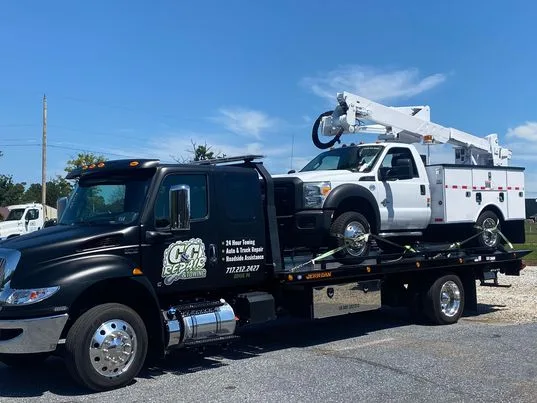
A disabled car can make an ordinary Harrisburg trip suddenly depend on a few details: the exact pickup point, whether the vehicle can roll, and where it needs to go. C&C Towing and Repair is listed in the Light Duty Towing category, but a category alone cannot establish which truck or roadside option is available for a particular call. A useful first call turns those details into a clear request before the driver is dispatched.
The listing identifies C&C Towing and Repair at 631 S 17th St, Harrisburg, PA 17104, and shows a 4.3 rating from 11 reviewers. Those are useful identity and reputation signals, not a promise about arrival time, current capacity, or the outcome of an individual tow. The decision should rest on what dispatch confirms for the vehicle and location in front of the caller.
Separate the provider address from the vehicle’s pickup point
The S 17th Street address is the business address shown in the listing; it should not be treated as the pickup location unless that is actually where the vehicle is. A caller should describe the vehicle’s exact position using a street address, cross street, parking-lot entrance, or a clear landmark. If it is on a shoulder or near moving traffic, say so immediately so dispatch can understand the setting.
Pickup access can matter as much as the map pin. A garage ceiling, narrow alley, gate, steep driveway, or blocked approach may affect whether a tow truck can reach the car. These are not assumptions about C&C’s equipment; they are details the dispatcher needs to evaluate. When the driver cannot safely wait beside the vehicle, the caller should say that early and follow any directions from emergency responders or roadway authorities.
Describe what the car can and cannot do
Before discussing a truck, the caller can report whether the engine starts, whether the wheels roll, and whether the steering and brakes appear usable. Mention missing keys, a locked steering wheel, collision damage, a low-clearance vehicle, or a car that is stuck off pavement. A vehicle that rolls normally may present a different loading situation from one with a disabled wheel or one that cannot be moved under its own power.
Ask whether the requested tow is within the provider’s current light-duty capability and what loading method would be used. If the vehicle’s drive system or condition makes a flatbed important, state that explicitly and ask dispatch to confirm the appropriate truck. If the car is stuck, ask whether winching or other recovery is offered for that situation. The listing’s category does not, by itself, confirm a specific service or equipment availability.
Make the destination and estimate concrete
A tow request is incomplete until the destination is clear. Provide the repair shop, residence, or other drop-off address, then ask whether dispatch can take the vehicle there. If the destination is not settled, ask how changing it would affect the quote rather than assuming a short distance or a particular route.
Ask for the estimated total or a price range and what it includes. Clarify whether distance, loading difficulty, waiting, after-hours timing, or a change in destination could alter the amount. No price is published in this listing, so the caller should obtain the estimate directly before authorizing service. The same applies to an arrival estimate: request the current window and ask how dispatch will communicate if it changes.
Use the listing details as a check, not a guarantee
The listed phone number is +1 717-774-3053, and the listing links to the official website at http://candctow.com/. A caller can use the number to confirm the company identity and describe the job; the website is another reference point for checking current information. Neither a directory label nor an online status signal proves that a truck is available at the moment of the call.
The 4.3 score from 11 reviewers offers limited public feedback context. A small review count cannot answer whether the right vehicle is nearby now or whether a particular tow fits the caller’s needs. The caller should compare what dispatch says against the actual pickup, vehicle condition, destination, and estimate, rather than treating the rating as a service guarantee.
Repeat the plan before ending the call
Before agreeing, the driver or vehicle owner can recap the pickup point, drop-off address, vehicle description, requested towing method, estimated cost, and arrival window. Ask which number the operator or driver will use if more information is needed. If the car is not owned by the caller or an insurer is arranging transport, clarify authorization requirements with the relevant party before dispatch.
For C&C Towing and Repair, the most useful measure of fit is a specific, current answer to the caller’s actual situation—not an assumption based on a listing. A concise report of location, access, vehicle condition, and destination helps both sides identify any mismatch before a truck is sent. If any essential point remains uncertain, resolve it on the call before committing to the tow.